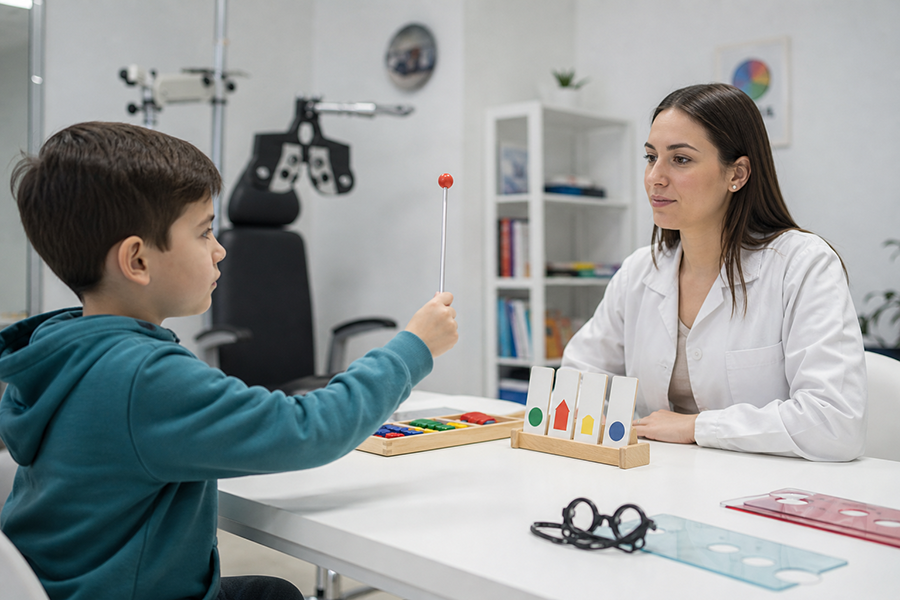
What is visual therapy? Visual therapy is a non-surgical treatment that trains the coordination between…

Presbyopia: restoring near vision with advanced solutions
Presbyopia is part of the natural process of visual ageing. However, it is now possible to correct it effectively and permanently, reducing or eliminating the need for glasses.
At INOF, we take a personalised approach to each case, combining clinical expertise with state-of-the-art technology to offer the best solution for every patient.
What is presbyopia?
Presbyopia is the progressive loss of the ability to focus on close objects, caused by a decrease in the elasticity of the crystalline lens, the eye’s natural lens.
It usually begins to appear from the age of 40–45 and develops gradually.
It affects everyone, regardless of whether or not they have other visual impairments.
How does it manifest itself?
The most common symptoms are:
- Difficulty reading or focusing on nearby objects
- Need to hold text further away to see it clearly
- A feeling of eye strain
- Discomfort following prolonged close-up work
If you experience these signs, it is advisable to undergo a full eye examination.
Treatment for presbyopia
There are now surgical solutions available that can effectively correct presbyopia, improving everyday vision.
These techniques also allow other refractive errors, such as short-sightedness, long-sightedness or astigmatism, to be corrected at the same time.
These are outpatient procedures with a quick recovery time and no need for hospitalisation.
Clear Lens Exchange (CLE)
The most commonly used technique is clear lens exchange, which involves replacing the natural lens with an intraocular lens.
It is a procedure similar to cataract surgery, but performed on an elective basis to improve visual quality.
What does this procedure achieve?
- Improve vision at different distances
- Reduce or eliminate dependence on glasses
- Correct other associated visual defects
Intraocular lenses
The choice of lens is crucial and is tailored to each patient’s individual characteristics.
Multifocal and trifocal lenses
These provide functional vision at distance, intermediate and near ranges, helping patients to become less reliant on glasses.
Extended depth of focus (EDoF) lenses
These offer excellent visual quality at distance and intermediate ranges, with a smooth transition between distances.
At INOF, we carry out a comprehensive assessment to determine the most appropriate treatment for each case, taking into account the patient’s visual needs and lifestyle.
If you have started to notice difficulty seeing up close or would like to explore the available options, you can book a consultation with our team. At INOF, we look after your eyesight.
Temas relacionados